
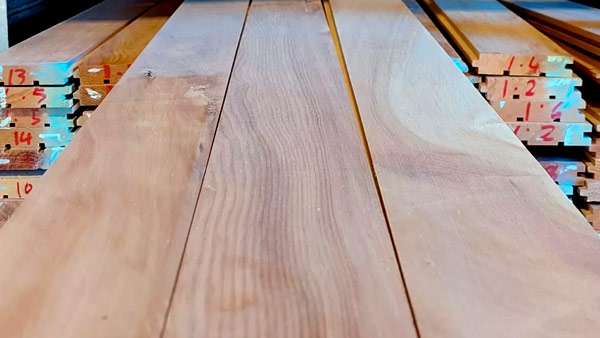
Matai timber, cherished in New Zealand, serves various purposes. Its dense, durable nature makes it a prime choice for flooring, where its rich, reddish-brown hue adds warmth to interiors. Matai’s fine grain and workability suit it for furniture crafting, producing pieces with both beauty and longevity. Beyond its functional attributes, the timber represents a connection to the country’s history, as it was widely used in early architecture. Thus, Matai timber remains a symbol of tradition, practicality, and aesthetic appeal in New Zealand.
Uses
- Flooring
- Bench tops
- Built-in furniture
Selection factors
- Recycled timber popular for flooring or built-in furniture and bench tops
- Dimensionally stable
- Accepts polish well
- Sapwood is prone to borer attack
| Common names | Matai |
| Species | Prumnopitys Taxifolia |
| General description | – Heartwood is golden/straw coloured – Sapwood is much paler – Fine, even texture – Straight grained – Relatively hard – Softwood |
| Origin | New Zealand |
| Sustainability | Limited quantities available from sustainably managed native forests |
| Availability | Limited new milling: recycled timber available |
| Durability & treatment | Non-durable; difficult to pressure treat; susceptible to borer attack |
| Drying | Dries readily |
Technical Specs
| Physical Characteristics | ||
|---|---|---|
| Shrinkage | Tangential | 3.5% |
| Radial | 1.9% | |
| Strength group | Unseasoned | S5 |
| Seasoned | SD7 | |
| Density | 610 kg/m3 | |
| Hardness | 3.4 | |
| Durability Class | Heartwood: durable; Sapwood: non-durable |